Develop Data-Driven Personas and Deliver a Tailored User Experience
 Personas Vectors by Vecteezy
While delivering a tailored, data-driven, user experience is high up on decision-makers’ priority lists, few know where to start and how to go about identifying their customers’ needs. Personas are a great way of identifying your customers’ needs and delivering a tailored user experience.
Over the past three years I built and experimented with data-driven personas on three occasions. Having familiarised myself with the general process, I’ve decided to share my learnings.
What are Personas and Why do we Need Them?
In an attempt to better cater to their customers, the concept of personas was developed. A persona is an archetypical customer profile aimed at helping organisations understand what their typical customers’ characteristics and preferences are, in relationship to the product offering. That is, personas should describe the archetypical customers’ reason for engaging with your product.
Personas are used for marketing and product design purposes. They allow product owners or designers to build products with a strong focus on how the consumers use them. Marketers typically use them to create relevant content for each archetypical customer and, by making use of the personas’ socio-demographic characteristics, they run targeted promotions — leading to lower cost per acquisition cost.
So profiling your customers can help you develop a better product by understanding and designing relevant solutions for your customers, and help you grow by accurately identifying and targeting the appropriate customer segments.
Good Personas Share Two Main Characteristics
In order for the personas to be successfully adopted by your organisation, the personas developed should be (i) representative and (ii)relatable. By representative I mean that there needs to be a clear, data-driven, link between the personas and their behaviour towards the product — they must represent actual customers. By realistic I simply mean that the personas need to be perceived as real, realistic or authentic individuals. If representativeness is missing, you risk that everyone’s focusing on a poorly defined, or plainly wrong, target market. If the personas are unrealistic, team members will struggle to engage with your personas. Either way, developing personas which aren’t realistic or representative could be an effort in vain.
A data-driven approach delivers more representative and relatable personas
From what I gather, personas were traditionally developed by making use of a combination of surveys, focus group interviews, and personal observations — with the occasional use of some company data. While this approach can be successful, traditional methodology has some notable shortcomings — chief amongst which are lack of statistical significance, and personal bias, and, consequently, rapidly outdating personas.
The lack of statistical significance is usually due to the high cost associated with collecting large samples of survey-based data. This is something that can be overcome in data-driven personas because actual customer data is typically used when developing them — and, provided that you have sufficient data (which is typically the case), the findings are more likely to be statistically sound.
Developing data-driven personas can also help overcome personal biases. By analysing actual behaviour, the preconceptions about your costumers are put to the test. This is much easier said than done. As Cassie Kozyrkov illustrates in this article, confirmation bias is, perhaps, the decision maker’s worst enemy. Start by listing your expectations with regards to your customers’ behaviour, the number of personas you think you’ll identify and what their characteristics are, before you look at the data, and prepare yourself to have your assumptions challenged!
Having statistical significance and steering away from personal biases pave the way towards more stable personas. Altogether, I believe that a data-driven approach implicitly delivers more representative and relatable personas. There are some other benefits data-driven personas have and this article sums them up well!
A word of caution..
The use of personas hasn’t been uncontested. There are alternative ways of understanding what your customers’ needs are and what product features you should be focusing on. A fifty-page white paper by Intercom makes the case that personas may not always be the best option. Since this is outside of this article’s scope, I’ll steer away from providing any guidelines in this regard.
Developing Data-Driven Personas
If you’ve decided that personas are suitable for you, keep in mind that the personas need to be representative and realistic.
How should one go about data-driven personas? While I believe that the approach can vary widely, I find that in practice and academia there is a generally applicable process. I’ll start with the data.
The three pillars of data

1.Demographic, Psychographic and Customer Interests Data
As I mentioned, the chances are that marketing teams want to reach the persona-specific audience through targeted marketing campaigns (think Facebook or GoogleAds), meaning that your personas will need demographic information; knowledge of your archetypes’ interests would also be helpful — I’ll call this the first pillar.
Demographic information is usually found within the company’s database. Admittedly, if your organisation is B2B, finding it might be trickier — but not impossible! Aside from demographic data, social media platforms also offer a wide range of user-interaction data, such as Facebook page likes, Facebook comments, posts,Tweets, posted photos, and so on. These can help you uncover your customers’ insterests and are usually accessible through the platforms’ API. This data could, in turn, could be fed through a tool like Crystal Knows in order to generate psychographic information. This entire process of extracting, transforming and loading the data can be time consuming and I’d let the organisation’s data infrastructure (and ambition of the initiative) guide how much of it to use for developing your personas. I’d like to note here that, while linking social media data to specific customers can be challenging, clustering it in isolation can provide useful insights also.
The first pillar data is important because it allows marketers to create content and target the personas, but also because it will help make your personas feel more relatable.
2.(Online) Behavioural Data
Online behaviour data makes up the second pillar. Google Analytics (in combination with Google Tag Manager), for example, can easily provide access to clickstream data, allowing you to understand your visitor’s online behaviour and how they interact with your product. While Google Analytics provides you with the functionality of linking clickstream data to the customer, it can take some time and effort.
The second pillar is useful because it reveals how the different archetypes interact with your product. This provides valuable insights to the product team and helps make the personas representative. In fact, online behaviour is so important that some studies focused on developing personas from online behavioural data alone. I’d definitely recommend reading this study!
2.Customer Data
The third pillar is business-related customer data. This is the data generated as your customers consume your product and it varies from one organisation to another. If you’re in the e-commerce business, for example, data related to purchased products might allow you to understand what type of products a persona is likely to purchase. If, on the other hand, you have a hidden business model, like Facebook does, you might find yourself more interested in the type of content-consumption behaviour the users engage in. This information is usually available within an organisation’s internal database.
This pillar provides similar uses as the second pillar, while it can also help make the personas more relatable. An insight derived from this data might sound like this for example: “Anna does most of her clothes shopping during the sale season”.
Lastly, depending on the number and quality of variables available, some feature engineering and dimensionality reduction might also be necessary.
Identifying the Archetypes

Having gathered, cleaned and pre-processed the data, start by splitting the data into two subsets — one for generating the personas (made up of ~70% of the data) and another (containing the remaining ~30%) for validating them (discussed later on). Next, remove the demographic variables before clustering the data. While age, gender, education, and so on, tend to be associated with customer behaviour, I prefer to let the customers’ behaviour point to the demographics instead.
Perform a visual analysis next. Aside from getting a general ‘feel’ for the data, looking into correlations between the customers’ (behavioural) characteristics and the product preferences is crucial. Finding that customers who make purchases on the weekend correlates with the purchase of specific products could be insightful, for example.
Generating personas should be an iterative process, starting with a simple model, validating the new personas (more on this later) and reiterating. To identify the archetypes start simple, with a k-means or hierarchical clustering algorithm, for example.
If you have qualitative data, spend some time analysing it now. If you can assign personas to the qualitative data, do so before you start distilling it, such that you analyse the qualitative data for each of the personas.
Opt for three to six personas, not more— at least in the beginning. This is because, the more personas you have, the higher the risk of finding unrealistic and unrepresentative personas, but also because it might be difficult for the organisation to adopt them. Once the customer data has been clustered, enrich the data with the demographics and produce the sumary statistics in order to identify the archetypes. At this point, assign personas to the validation data subset also — you’ll use this for validating your personas later.
Filling in the Persona Canvas
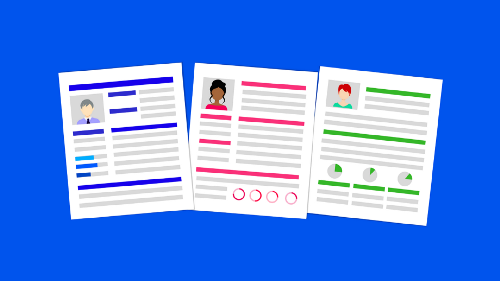
A Google Image Search for persona canvas will render a variety of canvas suggestions. These are some of the elements I think are unavoidable.
First, personas should inform team members about the personas’ preferences in relation to the products or services the organisation is offering. Then, persona-specific behaviours and characteristics derived from the socio-demographic data, such as typical behaviours or interests, age and gender, will help inform future marketing efforts to reach out the right audience.
Next, persona-representative images help team members relate and engage with the personas. Research shows that having a headshot and a few other contextual photos is better than opting for a single photo. Tread carefully though — your choice of pictures can alter how the personas are interpreted. Lastly, make sure to use the same person in all photos. Using more than one person to illustrate a persona can be confusing and ultimately leads to poor engagement with the personas.
Getting Organisational Buy-in

Organisational buy-in is critical to getting the rewards out of your persona initiative. If the organisation is not going to have faith and adopt your personas, future organisational efforts will not take into consideration the customer profiles and insights that come with them. Aside from promoting the initiative, I’ve come up with three suggestions which might help with organisational buy-in:
1. Ask for your colleagues’ opinion. I mentioned earlier that personas should be realistic. Asking a few colleagues to give you their opinion about the persona canvases could help you sass out whether your personas are indeed realistic.
2. Add a few photos for each persona. A study I’ve read suggests that showing multiple pictures for each persona (while making sure that one person for each persona is used!) can help make the personas more relatable or easy to engage with. The study cautions that the choice of photos can bias the users’ perception of the persona — so choose wisely.
3. Get colleagues onboard early on in the process. Involve all relevant parties early on. We tend to buy-in our ideas a lot more than others’. Getting people involved earlier on, asking for their input and opening up to collaboration will massively increase the chances of persona adoption. If you’re experimenting, for example, getting your colleagues in the marketing department involved in the experimentation phase might generate quite a bit of excitement and, if successful, everyone involved in the experiment will share the excitement that comes with it. That’s good momentum to build upon.
Validating Personas
Being data-driven should imply that validation is a necessity. For personas, validation can take multiple forms and is context-dependent. I’ve come up with three broad methods.
1. Persona specific engagement. The earliest sign of validation becomes apparent if your personas consistently engage with your organisation in a distinct manner, as identified by your development methodology. Check whether the personas developed seem to like or dislike specific features, products, services, and so on, offered by your organisation by looking at the summary statistics. You can also observe this by assessing your personas’ behaviour on the test data subset (remembering to check whether the personas’ demographics are similar between the two subsets). This is the easiest from of validation that can be applied, but also the cheapest, so I wouldn’t recommend stopping here.
2. Persona consistency. To make sure that the personas are consistent, I’d recommend at least re-running the final script or setup method with different subsets of the data. This helps maximise the chances that the personas are consistent and minimise the chance of developing unrepresentative personas.
3. Experimentation. To validate the personas more rigorously experimentation is necessary! Running an experiment, in the form of an A/B test, to test whether persona X is indeed more likely to react to a specific communication style, for example, can be very rewarding too, and help with organisational buy-in! Once the data driven personas are developed , focus groups could also be assembled in order validate your findings — as the saying goes, proof is in the pudding!
Conclusion
In this post I explained that personas serve two main purposes :
- to help marketing teams target and tailor communication for the right audience, and
- to allow product owners create a beautiful, engaging product.
I then provided a persona-development framework advising on the type of data needed, where to find such data, and how to develop and validate the personas. First, I broke down the data into three categories:
- demographic, psychographic and customer interests data
- (online) behavioural data, and
- customer data as it relates to your business.
After gathering and pre-processing the data, I recommended that you start with a simple analysis, develop no more than six personas, and decorate each persona canvas with more than one photo (using one person for each persona). I also mentioned that, to ensure organisational buy-in, it’s sensible to involve everyone early-on in the process, and ask for their opinion on your findings.
Lastly, I explained that persona development could take a few iterations before getting it right, so you might have to repeat the process a few times. Make sure to follow a thorough validation process to inform your success, by:
-
checking whether there are differences between personas and how they engage with your organisation’s offering.
-
re-running the analysis on different subsets of the data to check whether it renders similar results with different subsets of data, and
-
be it by running A/B tests, gathering focus groups or collecting survey data, validating your findings!
Note: I first published this article in April 2020 on medium.

Dragos Tomescu
Data Trainer (previously, Data Analyst)
A data analytics professional with a passion for understanding society. I write about data-driven applications and their impact on business and society.